Showing posts sorted by relevance for query gold. Sort by date Show all posts

Wednesday, July 31, 2013

What is the payoff structure of gold?


In an excellent new post, John Cochrane corrects some of Greg Mankiw's points on gold as an investment, writing:
In any case, Greg shouldn't have phrased the question, "how much gold should I hold according to mean variance analysis, presuming I'm smarter than everyone else and can profit at their expense by looking in this crystal ball?" He should have phrased the question, "how much more or less than the market average should I hold?" And "what makes me different from average to do it?"... 
As Greg points out, gold is a tiny fraction of [global] wealth. So it should be at most a tiny fraction of a portfolio.
Quite so. But even if one would not personally choose to make one-way directional bets on an asset, one might want to specify the asset's full state-contingent payoff structure, for those who do choose to speculate or to use the asset to hedge their idiosyncratic risks.

In other words, when does gold pay off? Cochrane tosses out a possible answer:
There is all this bit about gold, guns, ammo and cans of beans. If you think about gold that way, you're thinking about gold as an out of the money put option on calamitous social disruption, including destruction of the entire financial and monetary system. That might justify a different answer.
This idea is pretty common. But is it true? Would gold really pay off in the event of a calamitous social disruption? I'm really not sure that it would.

The basic idea here is that fiat money's value rests on the stability of governments; remove governmental stability, and people will go back to using gold as money (or at least to using gold-backed money), as in days of yore. If that happened, it would be handy to have stocked up a whole bunch of the suddenly back-in-use medium of exchange.

But I seriously question whether this would ever happen. See, both technology and the structure of governance have really changed since the days when gold was used for money. The assumption that the end of the Recent System (fiat money) would make us revert to the Old System (gold-backed money or gold as money) does not seem well-founded to me.

First of all, gold has always had a lot of limitations as a medium of exchange. Most notably, it is relatively easy to steal. To realize this, all you have to do is look at games like World of Warcraft, Diablo, Dungeons and Dragons, or the original Final Fantasy. In those games, gold is the money, and you often get gold not by doing an honest day's work, but by running around and beating people up and taking their gold. In other words, the entire world of modern fantasy role-playing is a subtle joke on gold's unsuitability as a medium of exchange.

Now in the past, people just sucked it up and dealt with this, spending large amounts of money and effort to guard their gold. But in the modern day, better alternatives are available. In particular, electronic security is cheaper than physical security. It's easier to guard digits than lumps of gold. In fact, in the case of gold-backed money (rather than physical gold money), you'd need electronic security in addition to guards at Fort Knox. Non-gold-backed digital currency is always cheaper to use than gold-backed digital currency.

So if fiat systems collapsed but electronic networks remained intact, it seems to me that we'd move to some sort of Bitcoin-type artificially scarce digital currency, rather than gold. Not Bitcoin itself, but some electronic currency managed by an institution with lots of staying power and respect. I'd put my money on ToyotaBucks.

OK, but what about a calamity so huge that electronic networks collapsed? In that case, wouldn't we have to go back to using physical money?

Maybe, but it wouldn't be gold. In the days when people carried around gold doubloons and whatnot as money, you had a global political system characterized by pockets of stability (the Spanish Empire, or the Chinese Empire, or whatever) scattered among large areas of anarchy. Those stable centers minted and gave out the gold coins. But in the event of a massive modern global catastrophe that brought widespread anarchy, the gold bars buried in your backyard would not be swappable for eggs or butter at the corner store. You'd need some big organization to turn the gold bars into coins of standard weights and purity. And that big organization is not going to do that for you as a free service. More likely, that big organization will simply kill you and take your gold bars, Dungeons and Dragons style.

In other words, I think gold is never coming back as a medium of exchange, under any circumstances. It is no more likely than a return of the Holy Roman Empire. Say goodbye forever to gold money.

So when does gold actually pay off? Well, remember that stories do not have to be true for people to believe them. Lots and lots of people believe that gold or gold-backed money in the event of a global social  disruption. And so when this story becomes more popular (possibly with the launching of websites like Zero Hedge?), or when large-scale social disruption seems more likely while holding the popularity of the story constant, gold pays off. Gold is like a credit default swap backed by an insolvent counterparty - it has no hope of actually being redeemed, but you can keep it around forever, and it goes up in price whenever people get scared.

In other words, gold pays off when there is an outbreak of goldbug-ism. Gold is a bet that there will be more goldbugs in the future than there are now. And since the "gold will be money again" story is very deep and powerful, based as it is on thousands of years of (no longer applicable) historical experience, it is highly likely that goldbug-ism will break out again someday. So if you're the gambling type, or if you plan to start the next Zero Hedge, or if your income for some reason goes down when goldbug-ism breaks out, well, go ahead and place a one-way bet on gold.

The only way gold will never pay off again is if practically everyone reads and believes this blog post. Not much chance of that happening!

Monday, July 21, 2014

You'll get no edge with Zero Hedge


(This post originally appeared at Bloomberg View.)


I can’t tell you that gold is a bad investment. Even after the recent plunge, if you bought gold in 2004, your investment would have earned you an annualized rate of about 10.4 percent, after accounting for inflation. That is darned impressive. If you bought in 1994, it would have earned about 3.9 percent per year -- not too shabby. Even if you bought all the way back in 1984, you would have earned 1.8 percent in real terms. (Of course, this assumes that shadowstats.com is wrong, and that inflation hasn’t been massively understated.)
In addition to delivering decent long-term returns, gold has been a way to spread or offset investment risk. As my co-blogger Yichuan Wang showed last year, gold’s return is somewhat negatively correlated with interest rates, so that a bet on gold is to some degree a bet on lower rates. This is actually the prediction of some old economic models, which also indicate that gold should have a positive rate of return over the long term. But a lot of the variance in the price of gold isn't explained by such factors, meaning that some small amount of gold is a valuable addition to any well-diversified portfolio.
But there are two big words of caution with respect to gold. The first is that you shouldn’t believe the standard story for why gold will go up. The second is that you should be very wary of websites and media outlets that constantly push you to buy gold.
The standard story for why you should buy gold is that it’s a hedge against the inherent weakness of the fiat money system. Unfortunately, it isn’t. For example, gold is a poor hedge against inflation. The correlation is very weak. Remember that gold had its huge bull run in the 2000s and a long slide in the '80s…but inflation was higher in the '80s than in the 2000s!
A more speculative and extreme version of the story is that the whole fiat money system is destined for collapse, and that after this happens we’ll go back to using gold as money. If that did happen, you’d want to own a lot of gold at that moment. Unfortunately, there are some big problems with this story, too. Technology has advanced to the point where we can use things like Bitcoin instead of heavy, easy-to-steal physical commodities like gold. And if civilization collapsed to the point where we couldn’t even use computers anymore, I’d advise you to invest in guns, ammunition, seeds and antibiotics instead of gold.
A bigger problem with the gold story is the question of why you should expect it to earn a good return. For gold’s price to keep rising steadily due to the failure of the fiat money system, it has to be the case that more and more people will steadily realize that the story is true. So a bet on this gold story is a bet that your macro perspective is way, way ahead of the macro perspectives of most other investors. That’s a highly speculative, risky bet.
So you should beware of media outlets that constantly push this story on you. The most important such website is probably Zero Hedge. If you read Zero Hedge, you’ll see this story about gold and fiat money being promoted again and again and again, often mixed with a healthy dose of political ideology and references to “Austrian economics.”
If you actually take Zero Hedge’s constant gold-flogging to heart, you could lose a lot of money. Since gold hit a peak in 2011, it has lost about 33 percent of its value in real terms. Zero Hedge kept touting gold all the way down. For example, in November 2011, Zero Hedge ran an article saying that gold could be “on its way to infinity.” In March 2012, Zero Hedge urged its readers to “stay long gold.” An October 2012 article made the same recommendation. As the price fell, Zero Hedge assured us that the collapse was only in “paper” gold, not the physical commodity. Needless to say, if you took Zero Hedge’s advice at any of these points, you would have lost a lot of money.
Now, if the gold crash is only temporary, and someday gold heads toward infinity, then losing money on paper is no problem…unless, of course, you have to sell to cover retirement expenses or pay some medical bills.
A lot of finance people seem to treat macro stories, like the one Zero Hedge pushes, as entertainment rather than actionable information. That’s a healthy attitude. And it’s true that Zero Hedge occasionally does some excellent reporting, or publishes other good information. So maybe you can read the site just for those tidbits, and either ignore or just smile indulgently at the huge volume of gold-flogging politics-tinged macro-propaganda that the site hurls at you day after day. But then you’re like one of those rare people who really does read Playboy magazine for the articles.
Zero Hedge is still pushing gold. It’s still pushing Austrian economics. But should you be listening? Only if you’re very good at separating bedtime stories from reality.

Thursday, August 22, 2013

What Determines the Return on Gold?


Sure, it's pretty. But what else?

Gold glitters, but from an investment perspective it does little else. It is backed by neither cash flows (like stocks are) nor a value at maturity (like bonds are). It's just a metal that, historically, has always been highly valued: a value that exists beyond its role in jewelry or in industry.

So what gives? Broadly speaking, when people make a bull case for gold, they tend to talk about two catalysts. First, they argue that because central banks are engaging in expansionary monetary policy, this will lead to massive levels of inflation that will drive gold prices higher. Second, they argue that gold is valuable because it acts like a panic button and serves as insurance against crisis. These in fact, were the primary motivators behind Paulson's famous bet on gold. In this post, I hope to show that the theory underlying (1) is flat out wrong, and that the logic behind (2) does not correspond to the actual challenging facing the world right now.

So let's first talk about inflation. The argument goes that since gold is a precious metal with "intrinsic" value, its price will rapidly appreciate in an environment of rapid inflation. Unlike a fiat currency, gold cannot be "debased" and therefore even if the Fed prints too many dollars, the gold coins will still hold onto their real value. In a world in which wheelbarrows of paper money buy only loaves of bread, gold will still make sure you can still eat. This value across all levels of inflation means that gold prices spike if inflation rises, and thus holding gold can hedge that risk.

Most arguments against this thesis have come down to (correctly) observing that central banks have not caused high levels of inflation. Given high levels of slack in developed economies, central banks are also unlikely to cause high levels of inflation. But this concedes too much. In truth, inflation hardly drives gold prices at all.

When people think of high inflation, they naturally gravitate towards the late 70's, early 80's -- a time of rapid growth in gold prices. But this was a special time for many reasons, not least of which was the United States decision to suspend dollar convertibility. But ever since those inflationary years, although gold has had its ups and downs, its price has actually been relatively uncorrelated with levels of inflation. In fact, if you look at the scatter plot below, you'll notice that the positive relationship between gold and inflation is almost entirely driven by three data points: 1974, 1979, and 1980. Once you drop those three years worth of observations, you go from the upward sloping dotted line to the solid downward sloping one. This suggests that inflation is actually a horrible predictor of where gold is going to go, and that we should look elsewhere for a guide.


So what is this other guide? Real rates. In fact, yearly return on gold is almost entirely determined by a the 10 year treasury yield minus the year over year inflation rate. To see this, consider the following scatter plot. Unlike the gold-inflation relationship, the real interest relationship is not driven by just a few data points. Both the 1970's and 2011 gold price spikes are explained by this relationship. Moreover, the relationship between the variables seems consistent through all levels of the real interest rate. This is evident from the fact that the non-parametric loess fit (the red line) and the linear fit are roughly consistent with each other.


This observation makes the most sense in the context of a Hotelling model -- a note that Paul Krugman has previously made. For a full explanation of the mechanics of the Hotelling model, I suggest you read Krugman's post. But the intuition for the model is that a higher real interest rate lowers demand for gold since the opportunity cost of holding it increases.

The relationship holds with more recent data as well. As seen below, the price of gold has been almost entirely determined by the yield on the 10 year treasury inflation protected security - a measure of future expected real rates. Admittedly, there is something puzzling going on. Whereas the historical relationship seems to run from gold growth rates to the level of the real interest rate, the gold price/TIPS relationship seems to suggest the gold price level is related to the level of the real interest rate. Nevertheless, the moral of the story is the same: higher real rates are bad news bears for goldbugs.


So why do people associate inflation with high gold returns, when in actuality gold returns are driven by real rates? It's because they reason from a price change and ignore the cause of inflation. The inflation seen in the 1970's and 1980's was very unique because it was the result of contracting aggregate supply, which had the effect of both raising inflation while also lowering the attractiveness of investment projects (i.e. lower real rates). However, inflation can also be the result of increasing aggregate demand. In this case, especially if the aggregate demand is pulling the economy out of a slump, the effect on the real interest rate is ambiguous to slightly positive. Therefore the relationship between gold and inflation is less clear cut.

This leads to an interesting conclusion about inflation hedges in general. Because there are two types of inflation -- supply and demand side -- it is important that you're careful with what kind of inflation hedge you're buying. If you're worried that "earthquake risks" will devastate the supply side of the economy, go ahead and buy gold. But if you're worried about a lack of central bank discipline, then you're better off buying the the 10 year inflation protected security while shorting the 10 year treasury.

So if gold isn't a good hedge against inflation, is it at least a good hedge against economic crises? Not all of them. If the crisis is one that leads to a fall in confidence and surge in desired savings, then real rates may fall and the price of gold may rise. But if the crisis is one that leads to a fall in savings and a rise in real rates, holding gold will end up exposing more of your portfolio to the worst of a crisis..

This is particularly relevant given recent Chinese and Indian economic stress.

If China undergoes a financial crisis, the most likely result will be capital flight. In this process, China will be forced to reduce its savings and investments as it rebalances. But in this case, since China will no longer be able to invest as many funds abroad, real rates rise and the gold price should actually fall.

Moreover, if China undergoes such a crisis its retail demand for gold will fall -- another strike against the insurance quality of gold.

Similarly, India's currency is under attack and its central bank may need to draw on its reserves of foreign currencies to stem the slide. Below I have a skew graph from a few weeks ago showing the depreciation that option markets were pricing in. As can be seen, there's quite a bit of depreciation risk in the tails. The effect of any such depreciation will be quite similar as in the Chinese case. Demand for foreign (i.e. American) assets will fall, thereby pushing U.S. real interest rates higher.


So while gold might have been good insurance it the past, it is not right now. Because the tail risks facing the global economy are much different than in the past, holding gold will end up amplifying risks instead.

The conclusion from all this analysis is that gold does not "march on a different beat." In the parlance of finance, it is not a source of uncorrelated returns. Nor is it a pure result of market psychology. In fact, given gold's relationship with real rates, it can be best described as a leveraged bet that real rates will fall. But with obscene amounts of volatility and low long run returns, it's not clear why anybody would want to hold gold at all.

Wednesday, January 16, 2013

Gold, gold, GOLD!!!


On November 11, 2011, Zero Hedge ran a post from a site called GoldCore. The title was: "Gold Over EUR 1,300 - On Way to ‘Infinity’ on Eurozone Contagion?" Here is what it said:
The unprecedented scale of the [European] debt crisis means that inflation and currency devaluations will almost certainly result from the crisis. Savers and those on fixed incomes will be very vulnerable as they were in the stagflation of the 1970’s and in the economic meltdowns seen in Argentina, Russia and in Belarus as we speak... 
However, the US is itself facing a debt crisis which is also of a monumental scale. It is of a scale that it cannot be resolved by the usual kneejerk resorting to the printing presses and today’s equivalent panacea - computer credit creation... 
Ron Paul gave another perceptive interview to CNBC yesterday and warned of hyperinflation and the possibility that the dollar could become worthless. 
When asked how high the gold price would go and why, he responded: 
“well, the question is how much lower is the dollar going to go in purchasing power? and I said to infinity unless we change our ways."
Here, courtesy of Goldprice.org, is a picture of gold prices over the past two years. Note that the Zero Hedge post appeared a few months after the peak:


For comparison, courtesy of Yahoo Finance, here is the S&P 500 over the same period:


Now, if you believed the Zero Hedge post, and immediately went out and invested $100 in gold, you would now have $17 less than a friend who ran out and invested $100 in an S&P index fund.

On March 6, 2012, Zero Hedge ran a post of its own, titled "Stay Long Gold", citing Morgan Stanley. If you believed that Zero Hedge post, and immediately went out and invested $100 in gold, you would now have $9.60 less than a friend who ran out and invested $100 in an S&P index fund.

Goldbugs and Zero Hedge fans who read these facts tend to make one or more of the following responses:

1. "You're cherry-picking. Go back 5 years and see how much gold has beaten stocks. Or 10 years."

2. "Look how much money central banks are printing. Obviously, fiat money is going to become worthless, and gold will be left as the one true form of money."

3. "OK, dude, whatever you say, look how much money I made investing in gold! Who's the fool now, huh?"

4. "Gold and stocks aren't substitutes. Gold is an important part of a diversified portfolio."

Number 1, of course, is just counter-cherry-picking. The S&P has beaten gold over every 30-year period of history, ever. Why 30 years? Well, it's a standard "long-term" investment horizon. But the same is true for 40 years, 50 years, etc.

Number 2 really fails to understand a basic idea about financial markets. If it's obvious that central bank money-printing will drive up the value of gold, why isn't that fact already incorporated into gold prices? In other words, the only central bank actions that should make gold prices rise are surprise actions - like printing even more money than people thought.

Now, Zero Hedge and the whole "goldbugosphere" tries to push the idea that they understand macroeconomics better than everyone else out there - that what is "obvious" to them is not obvious to most of the world, which is still in thrall to (Keynesians, neoclassical econ, Xenu, take your pick). 

But this also does not mean that gold prices can be expected to rise. Because even if it's true - suppose goldbugs are much much wiser and savvier than the rest of humanity - the only reason goldbugs wouldn't have already been able to push gold to its optimal price would be if goldbugs were liquidity constrained. But if that's the case, the only people who will believe in the predictions of higher gold prices will, by definition, be people who are unable to take advantage of their superior wisdom and savvy.

As for Number 3, note how it exploits a fairly well-known behavioral bias: Envy. When the gold flogger proudly boasts that "I made a fortune in gold!", people feel like unless they do the same, they aren't as smart as the guy making the boast. There's a knee-jerk psychological reaction of "If you can do it, well by golly, I can too!"

But notice how crazy this is. Even if you're as smart as the goldbug, it doesn't mean that you can replicate his success just by buying the same thing he bought. In fact, chances are you can't. Chances are, the huge gains that gold has seen over the past decade were a one-off event, not to repeated anytime soon. 

Investing is an area of human endeavor in which copying other people is not a surefire route to success. This makes it different from many other areas of life. If someone says "I tried the Atkins diet and I lost 40 lbs.!", then - assuming they're not BSing you - there's a pretty good chance that you too can lose 40 lbs. with the Atkins diet. Just copy best practice. But in investing, "copying best practice" by buying what the winners buy is actually just herd behavior, and is likely to make you lose money. Gold is not the Atkins Diet.

Of course, Zero Hedge knows this, and it knows that by creating this myth that "anyone can get rich by investing in gold", it can play on your own behavioral biases. Note that this is not the only bias they cleverly exploit - they also try to play to your masculinity in order to strengthen your overconfidence.

(As for Number 4, well, it might be right. But you shouldn't need Zero Hedge articles to tell you to diversify your portfolio! And let's be real: articles with titles like "Gold headed to infinity" and "Stay long gold" are not really articles about portfolio diversification.)

Note how there's a common theme here: Past performance is no guarantee of future results. According to "efficient" markets theory, past performance is unrelated to future results. According to behavioral finance research, future results will actually tend to reverse past performance, possibly because so many silly people exhibit herd behavior and jump on bandwagons.

Of course, as anyone knows who has ever tried to reason with goldbugs, this post is likely to fall mostly on deaf ears. But if you've had Zero Hedgie types brag to you about how much money they made investing in gold, don't feel bad. Look at their results in the last year and a half. And quietly snicker.


Update: as a commenter pointed out, Zero Hedge is probably just "talking their book". They own a bunch of gold, so right up until the point they're ready to dump it, they'll say "Buy, buy, buy!" Then they dump it, then they start yelling "Sell, sell, sell!" If it works, it's the old pump-and-dump scam, which is illegal when you do it to a stock, but perfectly legal to do when it's a whole asset class, like gold. Of course, Zero Hedge probably doesn't have a lot of ability to move gold prices, but why not try? In the meantime, they make money selling ads for their website. There's really no downside for them.

Monday, May 05, 2014

Geeks and money


Neal Stephenson is among my all-time favorite authors. Many dozens of hours of my youth were spent lost in the pages of a Neal Stephenson book, and yet I do not consider these hours "lost" in any way. Though Stephenson is best known for visionary science fiction, he is equally skilled as an ethnographer of geeks. As if that weren't cool enough, he occasionally serves up highly insightful commentary on the state of innovation.

Yet like his one-time protagonist Isaac Newton, Stephenson has always had a few curious obsessions unrelated to the main body of his work. Prominent among these is his interest in the phenomenon of money, which plays some kind of role in nearly every Stephenson yarn. Despite his general perspicacity, I'm afraid that Stephenson is as much of a mystic when it comes to monetary economics as Newton was when it came to alchemy.

For example, take his 1995 story, "The Great Simoleon Caper", in which he presages the development of a Bitcoin-like alternative currency. In that story, a protagonist laments the damage that inflation is doing to his savings:
I graduated college with a thousand bucks in savings. With inflation at 10% and rising, that buys a lot fewer Leinenkugels than it did a year ago.
Now, this is believable - a kid just out of college might be silly enough to keep his nest egg in a checking account even in a time of 10% inflation. But if he had half a milligram of sense, the kid would buy something whose interest rate was adjusted for the 10% inflation.

Remember, unexpected inflation hurts savers, but expected inflation doesn't. If inflation runs at 10% forever, people will just structure their nominal debt contracts to take this into account, by raising the nominal interest rate. In fact, this happened in response to the persistent inflation of the late 70s:

Figure 1 – Nominal Interest Rates, Real Interest Rates, and Inflation Rates, 1959–2008\

It's the unexpected swings in inflation that take away the ability of your savings to buy Leinenkugels (whatever those are).

On the next line, Stephenson offers an explanation for inflation:
"The government's never going to get its act together on the budget," Joe says. "It can't. Inflation will just get worse. People will put their money elsewhere."
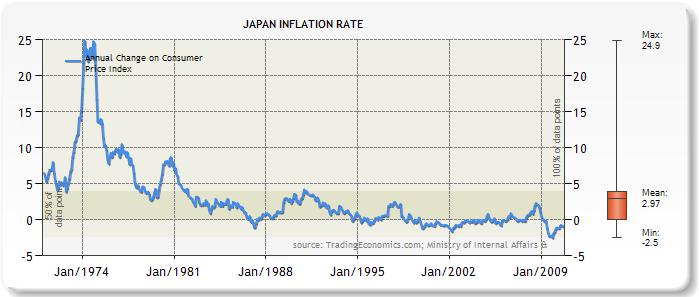
This is a theory called the "fiscal theory of the price level", and in Stephenson's defense it has been advanced by a number of prominent economists, including recent Nobel winner Chris Sims. But recent events in places like Japan have not been kind to this theory; even as Japan's government debt has skyrocketed to unprecedented, astronomical levels, the country has remained mired in deflation. Nor is Japan unique in this regard. Of course, Stephenson could not have known in 1995 that this would happen, so let's cut him some slack in this case.

In later writings, Stephenson wrestles with the age-old question of what exactly it is that gives money value. In his 2011 novel Reamde, which postulates a Bitcoin-like system merged into a World of Warcraft-style online game, Stephenson echoes a common trope about gold, a metal that in the past was often used to make coins that were used for transactions:
Gold, he learned, was considered to be a reliable store of value because extracting it from the ground required a certain amount of effort that tended to remain stable over time. When new, easy-to-mine gold deposits were found, or new mining technologies developed, the value of gold tended to fall.
Although the phrase "was considered to be" entails a certain amount of ambiguity, Stephenson must be given a rap on the wrist here for failing to notice that gold is not, in fact, a reliable store of value, and has not been one ever since governments stopped fixing the price of the metal. Here is a picture of gold's dollar price from 1970 through 2005:


As you can see, from 1980 through 2000, gold's value fell in dollar terms. If you were a 50-year-old living in 1980, and you bought gold under the impression that it was a "reliable store of value", then by the time you were forced to retire, you would have lost around half of your investment. Yet no major gold deposits or advances in mining techniques occurred between 1981 and 1982, when gold's price crashed precipitously. Gold lost its value because of something unrelated to the difficulty of getting gold out of the ground.

Money is a really weird thing, it turns out. It has to fulfill several roles at once - it has to be a stable short-term store of value, but also a medium of exchange and unit of account. Figuring out how it is that one object can fulfill all those roles - and when one of the roles might come to dominate the others - is no easy task. In fact, it turns out that there is a whole tribe of geeks - several tribes, actually - who have dedicated quite a lot of time and brain power to plumbing the mysteries of money. For example, in this excellent blog post (and also this one), David Andolfatto - a very smart geek who has spent quite a bit of time thinking about the nature of money - explains why gold is no longer used in transactions. (Happily for Stephenson and other Bitcoin fans, it turns out that Andolfatto thinks Bitcoin might someday end up being a lot better than gold - or anything else; see also here and here.)

In fact, the last few years have turned a lot of monetary theories on their head. Quantitative easing, which had scared quite a lot of people about the prospect of high inflation, ended up causing nothing of the kind. Gold climbed to dizzying heights and promptly lost a third of its value. Simple folk theories of money continued to prove incongruent with observed reality.

Geeks who are interested in money should know that if believers in a gold standard are like alchemists, there are a lot of very smart people out there trying to invent chemistry. The question of money demand is a hard one, and the human race doesn't really have good answers to this question yet. It's not a problem that was solved 400 years ago - it's a problem still waiting to be solved.

Tuesday, September 03, 2013

Four Ways to Answer Economics Questions


I recently came across a saying about the four ways of answering questions according to the Pañha Sutta.
  1. There are questions that should be answered categorically [straightforwardly yes, no, this, that].
  2. There are questions that should be answered with an analytical answer, defining or redefining the terms. 
  3. There are questions that should be answered with a counter-question. 
  4. There are questions that should be put aside.
A lot of the questions that economists get asked a lot can be answered in all four ways. I thought it would be fun to play a little "Economics Q&4A." I'll provide a few examples. If you wish, chime in with your own Q&4As in the comments.

Q: Is economics a science?
  1. Yes.
  2. This depends on exactly how you define science and what you consider to be the bounds and scope of economics. For the most part, economists cannot do controlled laboratory experiments. You can see lots of people's opinions on this question here, and you can read Mark Thoma and Paul Krugman here.
  3. Does this really matter? If it were not a science, should we stop trying to do it?
  4. **goes back to work**
Q: Is all this quantitative easing going to cause an inflation problem?
  1. No.
  2. You are probably asking about the Federal Reserve's unconventional monetary policies. For an explanation of why they haven't (and probably won't) cause problematically high inflation, see these posts.
  3. What do you mean by inflation problem? Isn't it possible that a bit more inflation would be a good thing? Do you see any signs of an inflation problem? Don't we have bigger problems than inflation?
  4. **sighs**
Q: If households have to tighten their belts, shouldn't the government?
  1. No.
  2. By belt-tightening, I presume you mean reducing the deficit of the federal government. You might have heard President Obama say, in 2010, "Small businesses and families are tightening their belts. Their government should too." But households are different than the government. You can read some bloggers' reactions here and here.
  3. Is the government a household?
  4. **slumps**
Q: How should I invest my money?
  1. Wisely.
  2. This depends on your situation and your financial goals. I don't know of any guaranteed get-rich-quick investment schemes. You should probably try to diversify, and not keep all your money under your mattress or in gold. I'm also not an investment adviser, just a young academic economist with no experience, so I'm horribly underqualified to help you with this.
  3. How much money do you have? And what are your investment goals? And why are you asking an economics grad student?
  4. **shrugs wildly**
Q: Should we go back on the gold standard?
  1. No.
  2. Here is an excerpt from Barry Eichengreen's answer: 
"Envisioning a statute requiring the Federal Reserve to redeem its notes for fixed amounts of specie is easy, but deciding what that fixed amount should be is hard. Set the price too high and there will be large amounts of gold-backed currency chasing limited supplies of goods and services. The new gold standard will then become an engine of precisely the inflation that its proponents abhor. But set the price too low, and the result will be deflation, which is not exactly a healthy state for an economy...The distributional effects of deflation are no happier than those of inflation.... The populist revolt of the 1880s was stoked by farmers with fixed mortgages who labored under growing debt burdens and financial distress as a result of falling crop prices. Nor is deflation likely to support robust economic growth, as any close observer of the Japanese economy will tell you.... 
And even if we are lucky enough to get it right at the outset, consider what happens subsequently. As the economy grows, the price level will have to fall. The same amount of gold-backed currency has to support a growing volume of transactions, something it can do only if the prices are lower, unless the supply of new gold by the mining industry magically rises at the same rate as the output of other goods and services. If not, prices go down, and real interest rates become higher. Investment becomes more expensive, rendering job creation more difficult all over again. Under a true gold standard, moreover, the Fed would have little ability to act as a lender of last resort to the banking and financial system...Its proponents paint the gold standard as a guarantee of financial stability; in practice, it would be precisely the opposite." 
3. What have you learned from history?
4. **cowers**

Q: When is Noah coming back?
  1. In about 3 months.
  2. If you mean coming back to the blog, that will be in about 3 months. However, he has never left Twitter. If you mean coming back to the United States, I think that already happened. 
  3. What, don't you like us?
  4. **checks watch**
Your turn!

Tuesday, September 25, 2012

EconoTrolls: An Illustrated Bestiary


In your journey through the Econ Blogosphere, you will be beset by a great many curious and interesting species of EconoTroll. At first you may be intimidated by their voluminous use of insider jargon, their rough-and-tumble personal attacks, their strenuous insistence that you read the complete works of their movements' founders before participating in any discussion, and above all their sheer persistence and apparent surplus of spare time. But fear not, noble traveler, for I have taken it upon myself to create this Illustrated Bestiary, in order to prepare you for (most of) the characters you will encounter on your way...
_________________________________________________________________________________

An Illustrated Bestiary of the Econ Blogworld

Libertarians

"Run for your life from any man who tells you that money is evil. That sentence is the leper’s bell of an approaching looter."

How they see themselves:

How the world sees them:
Favorite blog: EconLog

Favorite dead economist: Milton Friedman

Will appear in response to posts regarding: Trade, the environment, third-world labor, patents, immigration, education, the environment, sugary soft drinks, anything really

Craziest idea: Eliminate public education and legalize crack 

Special attack: Soaring rhetoric

Secret weakness: memories of the parties they didn't get invited to in college

Notes: This species of troll appears to be on the wane, as left-leaning college women have broadened their taste in men considerably, blunting the anti-liberal ressentiment that led to an explosion in the young angry libertarian male population...


Post Keynesians

"[I]t is always the outliers that are pushing back the curtain of ignorance. It's not the zebra in the middle of the herd, safely away from predators and mishaps, who finds the new food sources for the herd, or alerts the group to impending dangers."

"I'm not going to provide the links, but I called the crisis more precisely than any of those people."

How they see themselves:

How the world sees them:
Favorite blog: Steve Keen's Debtwatch

Favorite dead economist: Hyman Minsky

Will appear in response to posts regarding: Who predicted the economic crisis first

Craziest idea: That anyone is listening

Special attack: Anger

Secret weakness: the fear that Paul Krugman has said everything they've thought of, but better

Notes: When not engaged in bitter denunciation of the "neoclassicals" who supposedly pushed them out of their once-hallowed place in the halls of academia, this species can actually have quite a lot of interesting things to say...


Market Monetarists

"NGDP, NGDP, NGDP, NGDP."

How they see themselves:

How the world sees them:

Favorite blog: The Money Illusion

Favorite dead economist: No one. The spot is being reserved for Scott Sumner, along with thousands of life-sized terra cotta grad students.

Will appear in response to posts regarding: Monetary policy, macroeconomics, any word containing the letters "NGDP"

Craziest idea: Pegging the monetary policy of the world's leading nation to an obscure and highly illiquid futures market

Special attack: NGDP-style kung fu

Secret weakness: Supply shocks

Notes: Having now effectively swayed the Federal Reserve and won essentially all of the Econ Blogosphere to their way of thinking, the Market Monetarists can hardly be classified as "trolls" any longer...


Republicans

"[T]here are 47 percent...who are dependent upon government, who believe that they are victims, who believe the government has a responsibility to care for them...And so my job is not to worry about those people."

How they see themselves:

How the world sees them:

Favorite dead economist: Art Laffer

Will appear in response to posts regarding: taxes, politics, taxes

Craziest idea: Difficult to say, but probably a tie between bankrupting the country with debt, privatizing the prison system, invading Iraq, cutting funding for science, dishing out billions in pork to well-connected no-bid contractors, throwing millions of harmless marijuana users into nightmarish prisons, repressing gays, disenfranchising black voters, forcing millions of "illegal" immigrants into second-class citizen status, and blocking any sensible policy reform through the abuse of supermajority tactics in the Senate...

Special attack: Taking over the entire United States for three decades

Secret weaknesses: hot liberal chicks, fatty food

Notes: See also History, American, all


Austrians

"Cue hyperinflation in 5...4...3..."

"With real money backed by real gold, America experienced the greatest boom in any nation's history. Things were great and the American people flourished."

"No math needed. Read Rothbard. Economics (human action) is logic. Beautiful, simple logic."

How they see themselves:

How the world sees them:
Favorite blog: Zero Hedge

Favorite dead economists: Ludwig von Mises, Murray Rothbard

Will appear in response to posts regarding: Monetary policy, the gold standard, gold, and possibly pyrite

Craziest idea: That fractional reserve banking and fiat money are a conspiracy by the Rothschild family to take away people's freedom

Special attack: Real money, backed by real gold

Secret weakness: cannot withstand being subjected to intellectual contempt

Notes: For more on this odd and often frightening species of troll, please consult the fieldwork of the intrepid naturalist J. Bradford DeLong...


Modern Monetary Theorists

"Sorry, just to expand that further.....the currency would appreciate, but as there would be no market for government debt the govt would be forced to monetize. The increase in currency in circulation would offset the appreciation due to Acme share price increase. Assuming that the rise in Acme share price was due to the vast increase in demand for those shares as a consequence of the total rejection of govt debt as a savings vehicle, it is possible that the effect on the currency would be neutral..."

How they see themselves:


How the world sees them:
Favorite blog: yours

Favorite dead economists: G.F. Knapp, Wynne Godley

Will appear in response to posts regarding: Government debt

Craziest idea: That all of economics can be derived from a few simple accounting identities

Special attack: Jargon, jargon, and more jargon

Secret weaknesses: Mark-to-market accounting, logic

Notes: It has been said of this species of EconoTroll that holding a discussion with one is akin to "administering a Turing Test to a computer designed to impersonate an acute schizophrenic." Travelers are advised to proceed with extreme caution. Fortunately, this dangerous species has many natural enemies, and often the clever wayfarer can escape in the fracas between a Modern Monetary Theorist and an Austrian, Republican, or New Classical.


Marxists

"[it is] simple self-evident reality that the international monetary system was created by, and remains founded on, US military power. "

"capitalism will not be around for ever. An engine of infinite expansion and accumulation cannot, by definition, continue for ever in a finite world."

How they see themselves:

How the world sees them:
Favorite blog: None. Blogs are tools of capitalist oppression. Comment trolls of the world, you have nothing to lose but your word verification!

Favorite dead economist: Marx, duh.

Will appear in response to posts regarding: (actually, not sure about this one)

Craziest idea: Take your pick

Special attack: David Graeber

Secret weakness: the Postmodernist Essay Generator

Notes: We have not seen this species around much in recent years, but the tales of their infestations in far earlier times still make for lively campfire entertainment...


Scientists

"[M]acro is mostly a 'science' without falsification. In other words, it is barely a science at all. Microeconomists know this. The educated public knows this. And that is why the prestige of the macro field is falling."

How they see themselves:

How the world sees them:

Favorite blog: Noahpinion

Favorite dead economist: Are you kidding? That's the only good kind!

Will appear in response to posts regarding: Economic methodology, statistics, math

Craziest idea: That economists should do experiments

Special attack: the "economics isn't science" taunt

Secret weaknesses: bad posture, the knowledge that economists get paid more than they do

Notes: This troll, which periodically ventures into the Econ Blogworld, attempts to intimidate its enemies by the puffing up of its Physics Credentials in a strange sort of dominance display. This tactic can easily be defeated by immediately presenting the troll with a deceptively difficult or even insoluble math problem, and then ridiculing the troll for failing to solve it in short order.


New Classicals

"Krugman's blog post mainly tells us that his deficit in macro-knowledge persists."

"Get a life, Krugman!"

How they see themselves:


How the world sees them:

Favorite blog: New Monetarist Economics

Favorite dead economists: Frederic Bastiat

Will appear in response to posts regarding: Macroeconomics, history of economics, fiscal policy, stimulus, monetary policy

Craziest idea: That recessions are caused by a combination of A) people forgetting technology, B) people suddenly deciding to take vacations, and C) fear of future socialism by liberal politicians

Special attack: Dissing you anonymously on Econ Job Market Rumors

Secret weakness: the econ job market

Notes: This type of troll, long confined to a series of deep caves in Minnesota, emerged into the surface world and began marauding the landscape in response to attacks by the wizard Krugman. It is the sworn duty of all New Classicals to hunt down their antagonist and make him pay for his crimes. This makes them relatively harmless to travelers not affiliated with this grudge battle...


Uncategorizable

"The magical policy is MY GUARANTEED INCOME plan to auction the unemployed we can put 30M people to work 40 hours per week in less than 1 year this platform immediately reduces the cost of organizing and rehabbing the 12M homes that ARE gong from being owner occupied to rentals and my plan SOLVES for immigration [truncated]" 

How they see themselves:

How the world sees them:

Favorite blog: ...and how many times have you made a single argument against giving taxpayers the freedom to choose which government organizations they give their taxes to you've made ZERO arguments against tax choice don't you think it's just a little strange that you can't even make one argument [truncated] 

Favorite dead economist: ...against tax choice? I don't think it's strange...you know why? Because I know that you really don't want to embarrass yourself. there is no argument about them taking our jobs because IF the employer could hire the cheaper subsidized American he would the left over jobs are ones where there is true unfilled demand    [truncated]

Will appear in response to posts regarding: ...WHY DID YOU BLOCK ME mostly at the low end this field work that robots haven’t replaced yet by his definition my policy is magical bend to my will you haven’t proven yourself enough to get to take potshots why not just root for rampant fires to wipe out the unemployed [truncated]

Craziest Idea: ...when confronted with an insurmountable obstacle it's a good idea to break the obstacle down into smaller components that are easier to handle this is the divide and conquer strategy you'll never convince each and every taxpayer [truncated]

Special attack: ...you are just afraid to engage with my ideas because you know that i am intellectually as far beyond you as homo sapiens is beyond a slug why don't you come over here to boycott the entire government but you certainly will be able to convince every taxpayer to boycott at least one government organization [truncated]  

Secret weakness: nerve gas

Notes: The less said about this most fearsome species of troll, the better.